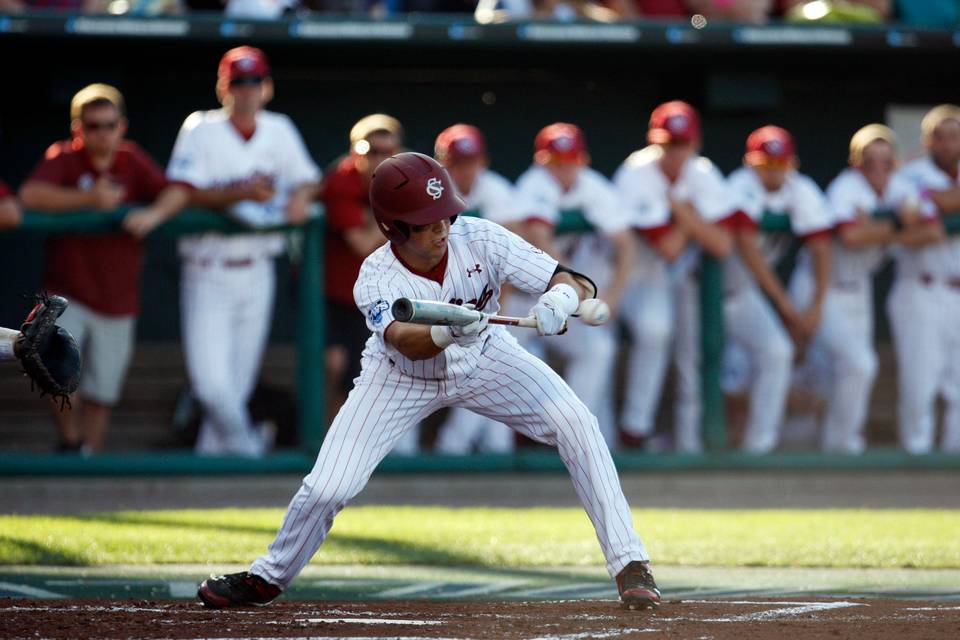
Is bunting a good thing? When is the right time to sacrifice? Or bunt for a hit? How about a good old-fashioned squeeze? There has been much debate over the years over the old-school approach taken by Gamecock skippers Ray Tanner and Chad Holbrook in regards to bunting. (Read: they LOVE the bunt.) But how often does it really work, and when is it not a good strategy?
This season, TRC will be the vessel for some deep-diving analysis from @chickenhoops, @featherdwarrior, and the team over at @DidtheBuntWork. The mission will be to put together some hard analytics to determine how effective the Gamecock bunt game is in 2017. Please enjoy this first installment from @chickenhoops.
Hi, you might remember me from such features as yelling about punting and Frank Martin’s lineups. Today, we’re here to talk about the third thing that drives me crazy – Chad Holbrook’s bunting.
I’m not exactly new to this topic, but with the help of others at @DidtheBuntWork, I’ll spend this year for the first time taking a systemic approach to Chad Holbrook’s fetish.
This is a bunt where I take no issue – Danny Blair attempted to bunt for a hit and it didn’t work. My general rule here is that this should be a player-called decision, but I’m not going to fault either Holbrook or Blair for trying.
Feb. 24 – Wright State
Inning: Bottom 5th
Score: 3-3 tied
Batter: Danny Blair
Lineup: 1st
Runners on: 2nd
Outs: 0
Did it work? Not even a little bit – Wright State threw the runner out at 3rd.
Expected runs added/lost: -0.25 (anticipated one out, runner on 3rd)
Expected chance of scoring once: +3% (70% to 73%)
Actual runs added/lost: -0.76
Actual chance of scoring once: 38%
Now this is the type of Holbrook bunt that we’ve come to know and love. In the fifth inning of a tie game, Chad decides to lower our total runs expected by a quarter of a run in exchange for a piddling three-percent chance of scoring. He ends up being right, one run would be enough to win the game, but that’s a pretty massive bet with 12 outs to go.
Of course, Blair can’t get it down and the runner is nailed. Here’s why it matters to little that there’s not much upside to these bunts – because look at the massive downside. Blair’s bunt doesn’t work, and now the Gamecocks go from slightly more likely to scoring once (but less likely to score more than once) to unlikely to score at all and unlikely to score much. No reward, all risk!
Feb. 25 – Wright State
Inning: Bottom 6th
Score: 4-0 USC
Batter: Danny Blair
Lineup: 9th
Runners on: 2nd and 3rd
Outs: 1
Did it work? Yes!
Expected runs added/lost: -0.24 (anticipated one run in, runner at 2nd, one out)
Actual runs added/lost: +0.73 (one run in, runners at 1st and 2nd, no outs) 2.06 to 2.79
Actual chance of scoring once: 38%
This is the flip side of the coin above – sometimes a team can’t make a play and a bunt turns good. Here, the bunt works as well as possible – the run gets in and both runners are safe. That increases the Gamecocks’ expected runs in this inning from 2.06 to 2.79 runs. Of course, Carolina would go on to score a 6-spot in this inning, effectively putting the game away.
We’ll try to catch up with the bunts we missed earlier in the season, but for this week’s games alone, here’s how Chad’s bunting turned out – let’s follow along this season as we finally take our NEVER BUNT thesis and test it over the course of an entire year.
Season-to-date (only including KSU and WSU series)
“Consider it all joy, my brethren, when you encounter various trials, knowing that the testing of your faith produces endurance. And let endurance have its perfect result, so that you may be perfect and complete, lacking in nothing.” – James 1:2-4, The Holy Bible (NASB)
I stood in one spot, arms crossed, practically motionless for roughly 45 minutes. It seemed like a lot longer. Hell, maybe it was, time was irrelevant to me at that point. All I knew the entire time was that I was watching, in relative terms, perhaps the greatest collapse in American sports history.
And it was happening to my team. My team for 40 God-forsaken years. A team that had one playoff win in its first 25 years of existence. A team that didn’t have back to back winning seasons until its 44th year of existence. A team that had fought past all the crappy history and playoff flops to race to a 28-3 lead over the mighty New England Patriots. They were finally the team all Atlantans had dreamt about – unquestionably the best in pro football.
Until they weren’t.
Slowly, painfully, it unfolded in front of my eyes. I told all the casual fans I was with “it’s over” at least five times over that last 45 minutes. After all, I’m a fan of all the Atlanta franchises, and I’m a fan of the South Carolina Gamecocks. This was old hat to me. I knew the ending long before anyone else.
I watched the confetti fall and saw Belichick hug Brady and that was all I could take. I thanked my hosts for a wonderful evening, got in my truck, and on the way home listened to the Falcons’ incomparable play-by-play man Wes Durham try to make sense of it all. He sounded as if he was describing the aftermath of a natural disaster.
I tried to sleep, but I kept replaying in my mind all the plays the Falcons could have made that would have changed the outcome. Each one felt like someone was punching me. It was almost physically painful. Then at some point I thought – is this the worst? Is this the worst ever? Because it feels like the worst ever. In a sporting life with the disappointments outnumbering the major accomplishments by a ratio of roughly 100 to 1, this really felt like the worst. So as I drove in on Monday morning, I tortured myself by trying to recall something worse, and it simply never arrived.
But it did spur (pun intended) this writing. For fans like me of the Atlanta franchises and the Gamecocks, this will be all too familiar. As fans of other teams you probably don’t give a crap, but hang in there and read along, for this is where my healing begins.
A couple of quick notes here. First, the 1984 Navy game is not included because I didn’t become a Gamecock fan until 1987. There are also a couple of surprises that don’t involve Atlanta or South Carolina. Don’t judge.
So, without further adieu, here are my top 10 sports defeats of all time:
Maybe in time this one will fall down the list, but I at the moment I really don’t see how. You know what happened, I don’t need to rehash it. The only thing I’ll say is RUN THE DAMN BALL SHANAHAN!
2. NCAA First Round, March 14, 1997 – (15) Coppin State 78, (2) South Carolina 65
The Gamecock basketball team had a magical run in 1996-97, led by the big three of BJ McKie, Melvin Watson and Larry Davis. They blitzed through the SEC slate and won their first and only conference championship, culminated by a stunning upset of Kentucky in Lexington on their senior day. But there was one thing I couldn’t shake heading into the NCAA tournament – how in the world did this team lose to UNC Asheville and Charleston Southern early in the season? That bothered me as a number two seed, that we could possibly play down to the level of our competition in the opening game. Well, Coppin State played out of their minds, and cemented our unfortunate place in the history books.
3. World Series Game 4, October 23, 1996 – Yankees 8, Braves 6
One year earlier, as Marquis Grissom squeezed the final out of the 1995 World Series, Bob Costas declared the Atlanta Braves the “team of the 90s”. They appeared to be on the verge of solidifying their grip on that moniker, with a 6-3 lead in the 8th inning of a game that could’ve given them a commanding 3-1 lead in the 1996 Series. Alas, Mark Wohlers hung a curve ball to Jim Leyritz, who tied the game with a 3-run homer. New York would go on to win that game in extra innings, and the series four games to two. The Yankees then went on to become the ACTUAL team of the 90s, while the Braves went on an unprecedented run of postseason futility . Until Sunday, that game was the most infamous in Atlanta sports history.
4. NCAA First Round, March 12, 1998 – (14) Richmond 62, (3) South Carolina 61
If Coppin State worried me, Richmond terrified me. The Spiders were an NCAA Tournament regular, pulling off the first 15-seed vs. 2-seed upset in the history of the tourney. Unfortunately this Gamecock squad wasn’t quite as good at the ’97 version and once again bowed out in humiliation.
5. College Football, November 18, 2000 – Clemson 16, South Carolina 14
The Falcons blew an early 17-o lead and a 24-10 halftime lead, a trend unique to Atlanta. The good news here was I was in the hospital with my newborn daughter, so I watched the game on a tiny hospital TV and was otherwise preoccupied. Still, pretty damn painful.
7. College Football Playoff, January 10, 2017 – Clemson 35, Alabama 31
For those of you who pulled for Clemson in 2016 and/or 2017 I will never understand you. Clemson winning a national title in anything, much less football, is never a good thing for us. Now we have to deal with merchandise, license plates, billboards, etc., until we can do something about it. Which might take a while.
8. College Football, November 23, 2003 – Clemson 63, South Carolina 17 and November 27, 2016 – Clemson 56, South Carolina 7
Basically the same humiliating game 13 years apart.
I really didn’t expect the Falcons to make the list three times when I first started thinking about this, but here we are. I was only 11 at the time, and don’t remember much about it except that I was extremely bummed. This game once again featured the Falcons building a big lead and collapsing at the end. Sound familiar?
10. College Basketball National Championship, March 28, 1977 – Marquette 67, North Carolina 59 and March 30, 1981 – Indiana 63, North Carolina 50
I know this surprises and possibly upsets some of you, but again I remind you I was not a Gamecock fan until 1987. Prior to that, North Carolina basketball was truly my first love. The UNC-Marquette game was the second sporting event I can ever recall watching (the first was Super Bowl XI between the Vikings and Raiders). I loved Dean Smith, I loved the Carolina blue and I decided that night the Tar Heels were my team. Of course they lost.
In ’81 the game between Indiana and UNC was almost postponed because President Reagan had been shot earlier in the afternoon. I remember thinking “looks like he’s going to live, let’s play ball!” (Hey, give me a break, I was a kid.) I got so frustrated with the game I would turn the TV off for 10 minutes at a time hoping that when I turned it back on the Tar Heels would have closed the gap. They never did, and I cried myself to sleep.
North Carolina would break through for their first, and my first, national title in 1982 behind the brilliance of Jordan, Worthy and Perkins. Of course I can’t claim that any longer because I now despise the Tar Heels with every fiber of my being. Was fun at the time, though.
Please, make me feel better and share your toughest defeats in the comments section.
Long-time friend of TRC and former Garnet and Black Attack contributor @FeatherdWarrior reflects on the anniversary of the death of former Gamecock head coach Joe Morrison.
Today marks the 28th anniversary of the death of Joe Morrison, probably the Gamecocks’ most successful football coach until the advent of Steve Spurrier nearly two decades later. Morrison’s death came as a shock to everyone and led to the eventual hiring of Sparky Woods as head coach – another tragedy, depending on whom you ask.
Not too long ago I came into possession of a copy of The Sumter Item from the day after Morrison passed away. The paper contains the AP’s account of Morrison’s death as well as his career. Most of what Gamecocks fans remember about Joe Morrison begins and ends with the 1984 “Black Magic” season, but it’s interesting to get a sense of atmosphere surrounding USC’s football program at the time. It’s also interesting to see what kinds of stories were in the news back then. I’ve transcribed the article about Morrison’s death below the line, and I’ve also included some of the other headlines from that day immediately below. I hope you find it as interesting as I did.
Dooley won’t run for governor – “Vince Dooley’s run for governor is over, less than two months after he announced retirement as the winningest coach in the history of the football-proud University of Georgia.”
Father advises Sanders to leave – “If Barry Sanders’ father has his way, the Heisman Trophy winner won’t return to Oklahoma State for his senior season.”
Kentucky board supports investigation results – “Members of the University of Kentucky board of trustees who attended a briefing on the school’s response to 18 NCAA allegations against the men’s basketball program said they supported the results of a 10-month independent investigation.”
Lakers are back, thanks to Jabbar – “The Los Angeles Lakers are back in sync, largely due to the improved play of Kareem Abdul Jabbar.”
Soviets out of Afghanistan; guerrillas close in on Kabul – “The last Red Army convoys abandoned their garrisons and headed north for home today, Soviet officials said, bringing to an end a nine-year adventure that cost more than 13,000 Soviet lives.
Bush heads for Canada this week – “Canadians looking for assurance that their country won’t be ignored by Washington now that a free trade agreement between the two countries is in place should be cheered by President Bush’s visit to Ottawa this week.”
Heart Attack Claims USC’s Morrison
COLUMBIA (AP) – South Carolina coach Joe Morrison, who brought the Gamecocks into the national spotlight with success on the football field and controversy off it, dies of a heart attack after playing racquetball with three friends. He was 51.
Morrison had been playing racquetball at Williams-Brice Stadium for about a half-hour with defensive coordinator Joe Lee Dunn, attorney Edward “Punky” Holler and businessman Ken Wheat before he suffered what Providence Hospital spokeswoman Dawn Catalano called a “massive heart attack.”
Morrison, who had a history of heart problems, was taken to Providence, arriving at 8:44 p.m. alive but unconscious. He was pronounced dead at 9:04 p.m.
Morrison was not feeling any pain but did have a “small, funny sensation near his elbow” after playing racquetball, Athletic Director King Dixon said. But when the players shook hands they noticed Morrison’s hands were “awfully cold,” Dixon said.
Dunn called trainer Terry Lewis, who in turn contacted the team doctor, who checked Morrison’s pulse and heartbeat, Dixon said.
“I think they were well within the range when the doctor got there. But they prevailed upon Joe to spend the night in the hospital to have a complete check, which Joe agreed to,” Dixon Said.
First, however, Morrison decided to take a shower. But during the shower, he collapsed. He was found there by one or more of his playing partners, who began performing cardiopulmonary resuscitation on the coach, Catalano said.
Morrison, a smoker, underwent a surgical procedures for removal of a blockage in a coronary artery in March 1985.
Dixon said Morrison, who had been on the road recruiting almost constantly since the season ended, had been sick about a week ago with a flu or virus that had left him “feeling awfully weak.”
“Coach Joe Lee Dunn said he had never seen Joe feel so badly in his life physically,” Dixon said.
Morrison, who played in the NFL for the New York Giants from 1959-72 as a running back and receiver, came to South Carolina after coaching stints at both Tennessee-Chattanooga and New Mexico. Morrison’s career record was 101-72-7 over 16 seasons.
He was 39-28-2 in six seasons at South Carolina, including 8-4 in 198, when he took the Gamecocks to the Liberty Bowl, where they lost to Indiana 34-10. South Carolina has never won a bowl game in eight tries.
The season was a controversial one, however. The Gamecocks faltered near the end, losing four of their last six games. That came on the heels of allegations of steroid use among football players by former Gamecock defensive lineman Tommy Chaikin.
In a story in Sports Illustrated, Chaikin, who played at South Carolina from 1983-87, said he and other players used steroids and about half of the 1986 team used the muscle-building drugs. Chaikin also said some players used drugs such as cocaine and LSD.
Morrison he had heard rumors some players might have been using steroids but the allegations were never substantiated.
The allegations by Chaikin have prompted a grand jury investigation that is expected to continue when jurors reconvene later this month.
University President James Holderman said he didn’t think Morrison was under any added pressure this year.
“I don’t think he was under any more stress than any football coach was under,” Holderman said.
Dixon agreed.
“I did not detect any more stress on Joe this year,” Dixon said.
Morrison’s private life was the focus of intense scrutiny two years ago when it was learned he has had a child by a woman he began seeing while he was at New Mexico. The woman, Barbara J. Button, moved to South Carolina after Morrison became coach of the Gamecocks.
Morrison acknowledged he was the father of Button’s daughter, Lisa Nicole Morrison, who was born June 12, 1982 in Albuquerque, N.M.
Despite the controversies, Morrison was known as a winner as a coach and a player. Morrison’s best year at South Carolina was in 1984 when he was named the 1984 Walter Camp national Coach of the Year. South Carolina went 10-2 that season, losing to Oklahoma State 21-14 in the Gator Bowl.
Morrison began his coaching career at Tennessee-Chattanooga after former Giants teammate Sam Huff recommended him for the job. The Moccasins went 4-7 in each of his first two seasons, then went 5-5-1 in 1975.
Over his final four seasons there, Morrison coached the team to records of 6-4-1, 9-1-1, 7-3-1, and 9-2, winning the Southern Conference championship three times.
He moved to New Mexico in 1970 and the Lobos went 4-7 in his first two seasons at Albuquerque. New Mexico went 10-2 in 1982, its only loss 40-12 to Brigham Young.
South Carolina hired him away Dec. 5, 1982. The Gamecocks went 5-6 in his first season, then went 10-2 in 1984, rising as high as second in The Associated Press poll before a 38-21 loss to Navy on Nov. 17. The Gamecocks finished 1988 (sic) ranked 11th.
South Carolina was 5-6 in 1985, 3-6-2 in 1986 and 8-4 in 1987, finishing with a 20-16 loss to eventual national champion Miami of Florida and a 30-13 loss to Louisiana State in the Gator Bowl.
Morrison, who was born August 21, 1937, and grew up in Lima, Ohio, was as outstanding a player as he was a coach. At Cincinnati, he set school records in scoring, passing and rushing and twice was named to the All Missouri Valley Conference team.
He led the Bearcats in rushing and receiving in 1958. He played in the 1959 College All-Star Game, Senior Bowl and North-South All-Star Game.
After graduating in 1959, he was drafted on the third round by the Giants and went on to play 14 years for New York, earning the nickname “Old Dependable” for his clutch play.
He was named Most Valuable Player by the NFL Touchdown Club in 1972, his final season. The Giants that year retired his No. 40.
Morrison is the Giants’ all-time leader in receptions with 395, for 4, 993 yards and 47 touchdowns. He gained 2,472 yards rushing in his career on 677 carries, scoring 18 touchdowns.
His 65 career touchdowns rank him fourth in the history of the Giants with 390 points.
“He was such a versatile player,” Giants owner Wellington Mara said. “ He was the ultimate team player. He would do anything you asked him. Run the Ball, catch, play on special teams, anything.”
Dunbar Funeral Home was handling the arrangements, but they were incomplete this morning.

 “Consider it all joy, my brethren, when you encounter various trials, knowing that the testing of your faith produces endurance. And let endurance have its perfect result, so that you may be perfect and complete, lacking in nothing.” – James 1:2-4, The Holy Bible (NASB)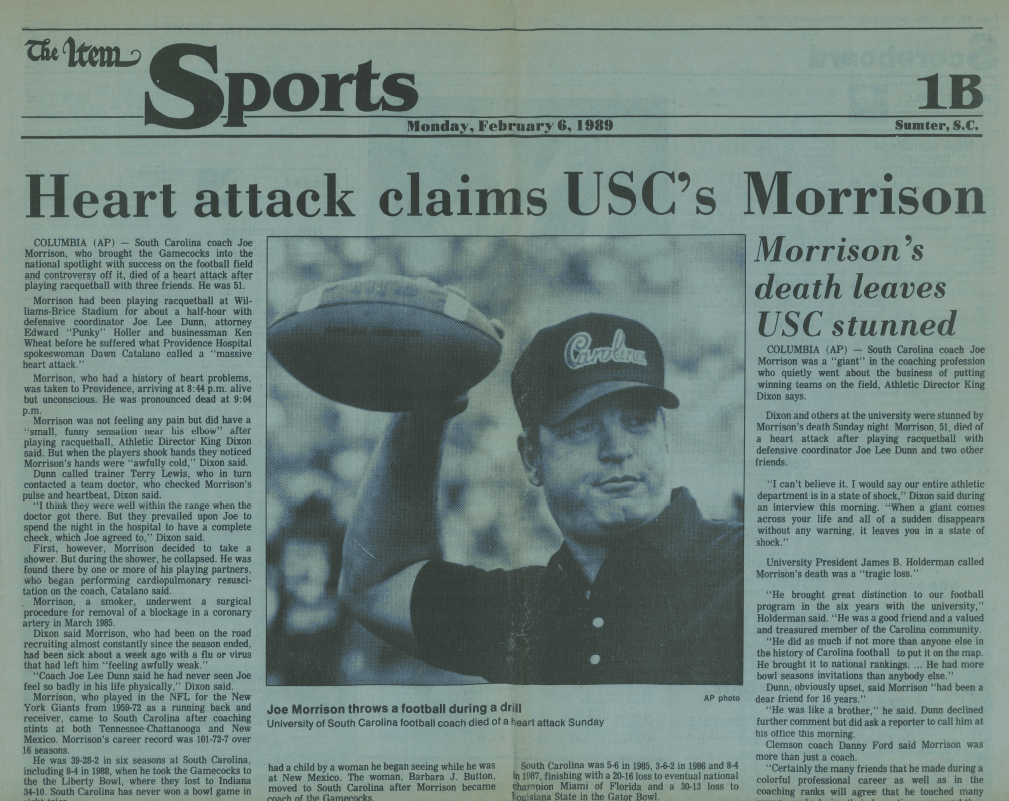
 The Rubber Chickens Blog